Fun Workshops Singapore

Quick answer: pick the workshop by what the group needs, not by what the activity is. A team that has not met in person needs something long and conversational. A group that already knows each other can take something competitive or difficult. Getting that backwards is why workshops fall flat more often than the activity itself is.
So this list is sorted by the goal rather than by the type.
If the group barely knows each other
You want low stakes, no performance, and enough time for people to stop being polite.
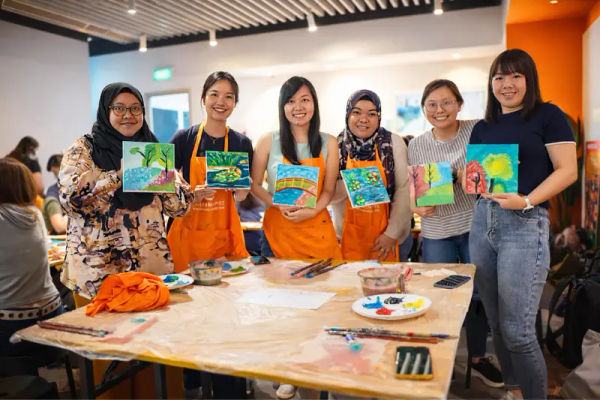
Painting is the strongest option here, for a reason that is structural rather than aesthetic: everyone is occupied, nobody is watched, and conversation happens sideways while hands are busy. People who would say nothing across a lunch table talk while painting. Take the longer format — the first hour is warming up, the second is where anything happens.
Terrarium or candle making works similarly, on a shorter timescale.
What to avoid: anything competitive, anything requiring a volunteer, anything where one person’s contribution is visible to the room.
If the group already knows each other well
The risk here is boredom rather than awkwardness. You can afford difficulty.
Pottery is reliably funny, because everyone fails at first. Leatherwork asks for real precision. Cooking works if the kitchen is big enough for everyone to actually cook rather than watch.
What to avoid: another icebreaker. A team that has worked together for years does not need to learn each other’s names again.
If you want something on the wall afterwards
A team mural — one large canvas painted collectively, then hung in the office. It changes the dynamic from thirty individual activities to one shared object, and it is the version people point at months later.
Tote bags are the other end of the same idea: everyone leaves with something they use rather than store, which for a distributed team is often better than something for a wall nobody shares.
If the group is large
Above about forty, most workshops break. The question to ask is whether the activity needs equipment everyone uses at once.
Painting scales because it does not — one canvas each, no shared tools, no queue. Sixty people painting looks the same as ten people painting, only louder.
Pottery does not scale, because it needs a wheel each. Cooking scales badly for the same reason.
Anything else needs a rotation, and rotations mean a proportion of the room is always waiting. Worth knowing before you book, not after.
If the slot is short
Under 90 minutes, choose something that finishes: candles, soap, terrariums, an Express painting session on a small canvas. Avoid anything with drying or setting time, because that is where a short session turns into people standing about.
If people are burnt out
The instinct is to book something energetic. Usually wrong.
What tired teams tend to want is something absorbing and quiet — an activity that occupies attention without demanding energy. Painting does this well, and the reason is mundane: it takes enough concentration to crowd out work thinking, and not so much that it becomes work.
Worth being careful about the language, though. A painting session is not therapy, and describing it as wellness support oversells it in a way people notice.
What actually makes a workshop land
- Everyone doing something the whole time. The single biggest differentiator, and the one most easily checked in advance.
- Enough time. Most workshops are booked too short. The good part is usually in the second half.
- No performance. Anything requiring someone to present to the room excludes a third of it.
- Something to take away. An object keeps the session alive far longer than a photograph.
- Mixed seating. Left alone, people sit with the colleagues they already talk to. Costs nothing to change.
Working out what to book
Answer three questions and the choice usually makes itself: how well does the group know each other, how many are there, and how long have you got.
What separates a good craft workshop from a filled hour covers the questions to ask a provider, and the difference between a class and a jamming session is worth reading if you are choosing between them — a class has an instructor and an outcome, and for a group that is usually not what you want.
Corporate sessions run at our studio or at your office, and team building sessions are the same activity framed around a group that needs to work better together. Send a date and rough numbers for an itemised quote.
More on classes and studios
Craft Workshops Singapore
Craft workshops in Singapore, what separates a good one from a filled hour, and what to check before booking for a group.
Read it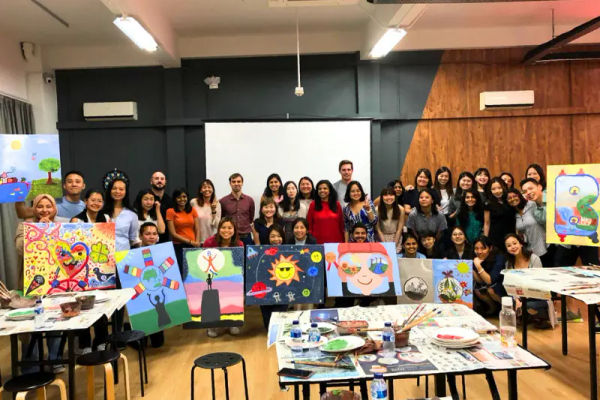
Art Classes Singapore
The difference between an art class and an art jamming session, which suits which goal, and what each one costs in Singapore.
Read it
Art Studios Singapore
Where to paint in Singapore, what to look for in a studio, and what the difference is between hiring a space and joining a session.
Read itReady to paint something?
Tell us your date, group size and venue. A written, itemised quote comes back within 24 hours.