Craft Workshops Singapore

Quick answer: a good craft workshop gives every person something to do for the whole session, finishes inside the time, and sends everyone home with an object. A bad one has people waiting for equipment, watching a demonstration, or leaving with something half-made and a promise to collect it later.
That is the whole test, and it is worth applying before you book for a group.
What separates a good workshop from a filled hour
Everyone is occupied the whole time. The failure mode is a workshop built around one piece of equipment — one wheel, one press, one machine — where most of the room waits. Fine for four people. Poor for twenty.
It finishes. An object you take home beats an object you collect in three weeks, especially for a group that will not reassemble.
Nobody has to be good at it. The best group workshops have a low floor: the first attempt is acceptable. Anything with a visible skill gap splits the room into people enjoying themselves and people quietly not.
There is a facilitator, not a lecturer. Circulating and answering questions works. Demonstrating from the front while twenty people watch does not.
The main types, and who they suit
Painting
Everyone has a canvas, everyone paints for the full session, everyone leaves with something. No shared equipment, no waiting, and it scales from five people to sixty without changing shape. That is the practical reason it dominates corporate bookings — what groups actually enjoy goes into how it compares to the alternatives.
Pottery
Genuinely enjoyable and the hardest to scale. Wheel throwing needs a wheel each, and firing means the work arrives weeks later. Excellent for eight people, awkward for forty.
Candle and soap making
Approachable, quick, reliably successful. The catch is that the making is short — often under an hour — so the session needs something either side of it, or it ends early with people looking at each other.
Terrarium building
Popular for a reason: everyone succeeds, the object is nice, and it takes about the right amount of time. Less absorbing than painting, because the decisions run out sooner.
Leatherwork
Produces the most useful object on this list — a card holder, a keyring. Slower and more precise, which suits smaller and more patient groups.
Printmaking
Lino and block printing scale reasonably if there are enough tools. The one-colour, hard-shape constraint does the design work for beginners, which is a real advantage.
What to check before booking for a group
- Is there equipment everyone needs at once? If yes, ask how many there are. This is the question that most often exposes a workshop that does not scale.
- Do we take the thing home the same day? Anything fired or cured does not.
- What is the facilitator-to-participant ratio? One person for forty is crowd control, not facilitation.
- What happens if someone has never done it? The answer should be “nothing special”, not “we’ll help them catch up”.
- How long is the making, as opposed to the session? A three-hour booking with forty minutes of activity is a long forty minutes.
- Can you come to us? Venue flexibility changes the cost and the logistics more than anything else.
Matching the workshop to the group
Corporate teams. Individual activity, no shared equipment, works at scale, everyone leaves with an object. Painting fits this precisely, which is why it gets booked. Corporate sessions run at a studio or at your office.
Mixed-ability or mixed-age groups. Lowest possible floor. Painting, terrariums, candles.
Small groups who want a challenge. Pottery and leatherwork, where the difficulty is the point.
Large cohorts. Anything that runs in rotation, or anything genuinely per-person. Ask about the equipment ratio first.
Short slots. Candles, soap, terrariums. Avoid anything with drying or setting time.
What a session actually includes
For painting, that means canvas, acrylics, brushes, palette and apron per person, plus a facilitator who sets up, runs it and clears up. Nothing to bring, nothing to buy on the day, and the painting goes home with whoever made it.
Sessions run one to two and a half hours, including neon versions under blacklight. The longer format is the one to book if the reason you are booking is the group rather than the object — the conversation tends to start in the second hour.
Working out what to book
Start from what the group needs rather than from a list of activities. A team that has not met in person wants something long and conversational. A cohort of eighty wants something that runs in rotation. A team of eight who see each other daily can afford something harder.
Studio sessions and the difference between a class and a jam cover where painting sits in all this — the distinction matters, because a class has an instructor and an outcome, and a workshop of this kind deliberately has neither.
More on classes and studios

Fun Workshops Singapore
Workshops in Singapore that groups actually enjoy, sorted by what the group wants out of it rather than by activity type.
Read it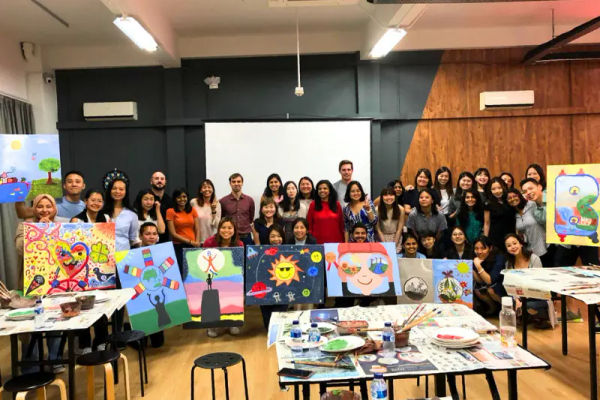
Art Classes Singapore
The difference between an art class and an art jamming session, which suits which goal, and what each one costs in Singapore.
Read it
Art Studios Singapore
Where to paint in Singapore, what to look for in a studio, and what the difference is between hiring a space and joining a session.
Read itReady to paint something?
Tell us your date, group size and venue. A written, itemised quote comes back within 24 hours.